Carmel-by-the-Sea
Municipal Code
Chapter 2.04
CITY COUNCIL*
2.04.140 Reconsideration of Council Action.
Any City Council member voting in the majority on any given item may move reconsideration of Council action on that item for consideration at a future meeting. (Ord. 98-6 § 1, 1998; Ord. 127 C.S. § 1, 1966; Code 1975 § 211.1).
Reconsideration of the City Council’s decision that the Palo Alto Saving and Loan Building does not qualify as an historic resource would therefore require one of the City Council members who voted in the majority to move reconsideration of Council action i.e., City Council Members Michael Cunningham or Gerard Rose.
MINUTES
CITY COUNCIL MEETING
CITY OF CARMEL-BY-THE-SEA
November 7, 2006
VII. CONSENT CALENDAR
I. Consideration of Findings for a Council decision determining that the Palo Alto Savings and Loan Building located in the Service Commercial District does not qualify as an historic resource. (Blk 91, Lots 2, 4, 6, & 8).
Mayor McCloud pulled Item I.
Mayor McCloud spoke regarding the Palo Alto Bank Building. Olof Dahlstrand, Brian Congleton, Miriam Schakat, Rich Barrett, Elinor Laiolo, Monte Miller, Fred Kern, John Mandurrago, Bill Strid and Joe Mashock addressed the Council regarding the Palo Alto Bank Building.
Mayor McCloud closed the hearing to public comment at 6:12 p.m.
Council Member Hazdovac, Mayor McCloud and Mike Cunningham discussed the Item.
Council Member ROSE moved to adopt the Findings, seconded by Council Member
CUNNINGHAM
Council Member Bethel amended the motion to have the last two sentences in Finding 38 deleted; and
Council Member Hazdovac amended the motion to add, in Finding 36, Barnet Segal was a founding member of the Carmel Business Association and started the bond to build the Carmel Fire Station; and
Mayor McCloud amended the motion to replace, in Finding 38, the last two sentences with note that Barnet Segal established the Carmel Art Association carried as amended by the following roll call:
AYES: COUNCIL MEMBERS: BETHEL, CUNNINGHAM, & ROSE
NOES: COUNCIL MEMBERS: HAZDOVAC & McCLOUD
DECISION RECORD:
19 December 2005: The Historic Resources Board (HRB) voted unanimously to uphold the appeal, reverse staff’s determination, and place the property on the Carmel Inventory of Historic Resources.
8 June 2006: The City Council deliberated on the appeal and determined that the building did not qualify as historic for architectural reasons.
3 October 2006: The City Council deliberated on the appeal and determined that the building did not qualify as historic for its association with historically important persons.
7 November 2006: The City Council adopted findings overturning a decision of the Historic Resources Board determining that a commercial structure, designed by Walter Burde and known as the Palo Alto Savings And Loan Building, is eligible for the Carmel Inventory of Historic Resources.
Showing posts with label Palo Alto Savings and Loan building. Show all posts
Showing posts with label Palo Alto Savings and Loan building. Show all posts
Sunday, December 31, 2006


Saturday, September 30, 2006
Barnet Segal's Association with Palo Alto Savings & Loan Building
CITY OF CARMEL-BY-THE-SEA
City Council Agenda
Regular Meeting
October 3, 2006
VIII. Public Hearings
A. Consideration of an appeal of the Historic Resources Board determining that the former Palo Alto Savings and Loan building is historically significant and listing the property on the Carmel Inventory of Historic Resources. The appellant is John Mandurrago representing the Pacific Grove Land Company. The property is identified as Block 91 Lots 2, 4, 6 & 8.
Selected excerpts from the city's public record, as follows:
CITY OF CARMEL-BY-THE-SEA
STAFF REPORT ADDENDUM
TO: MAYOR McCLOUD AND COUNCIL MEMBERS
FROM: BRIAN ROSETH, PRINCIPAL PLANNER
DATE: 12 SEPTEMBER 2006
SUBJECT: CONSIDERATION OF AN APPEAL OF A DECISION OF THE
HISTORIC RESOURCES BOARD DETERMINING THE FORMER PALO ALTO SAVINGS AND LOAN BUILDING IS HISTORICALLY SIGNIFICANT AND LISTING THE PROPERTY ON THE CARMEL INVENTORY OF HISTORIC RESOURCES.
I. INTRODUCTION
On 1 August 2006, the City Council continued the Plaza del Mar appeal with a request that staff evaluate new evidence in the record that linked Walter Burde's Palo Alto Savings and Loan building with Barnet Segal - a potentially important person in Carmel's history.
II. BACKGROUND ON HISTORIC FIGURES AND PRESERVATION
There are four categories used in classifying historic resources. These are:
(1) The resource is associated with events that have made a significant contribution to broad patterns of local or regional history or the cultural heritage of California or the United States; or
(2) The resource is associated with the lives of persons important to local, California or national history; or
(3) The resource embodies distinctive architectural characteristics of a type, period, region, or method of construction or represents the work of a master or possesses high artistic values; or
(4) The resource has yielded, or has the potential to yield, information important to the prehistory or history of the local area, California or the nation.
Criteria-2 properties are considered historic if they are closely associated with the lives of people that are important to the physical or cultural development of a city, region, state or nation.
For a property to qualify under Criteria-2, it must be very closely associated with the important person that it is supposed to represent. Weak associations are less effective in the public education/interpretation goal of historic preservation. If there is more than one property that might represent an important figure, preserving the one with the strongest associations is the usual practice.
Criteria-2 resources should be related to the period of time when the important person was doing whatever made him/her important. If an important author lived in several different homes, it is most appropriate to preserve the home where the author produced their most important works.
Evaluating Properties Less Than Fifty Years Old
Eligibility for Exceptional Importance
The phrase "exceptional importance" does not require that the property be of national significance. It is a measure of a property's importance within the appropriate historic context, whether the scale of that context is local, State, or national.
Comparison with Related Properties
In justifying exceptional importance, it is necessary to identify other properties within the geographical area that reflect the same significance or historic associations and to determine which properties best represent the historic context in question.
III. DOES THE EVIDENCE SUPPORT A CRITERIA-2 DESIGNATION?
Was Barnet Segal an Important Person?
Barnet Segal was a man of great accomplishments. His legacy continues even after his death because of the charitable trust he created. He established Carmel's first bank. This is an important milestone in the development of any young city. It is one mark of a city's growing substance, maturity and permanence. Known by locals as "Barney's Bank," it provided loans for construction of many of the homes and commercial buildings that make up the character of Carmel. The respect that he earned, and his value to the community were so widely recognized that he was often called "Mr. Carmel." He helped establish the Carmel Art Association, an institution important for Carmel's burgeoning art community and a continuing presence today. All of these contribute to a determination that Barnet Segal was an important person in Carmel's history.
Designating a building as historic on the basis of an important person requires a finding that the person was of exceptional importance.
Is the Property or Bank Building Closely Associated with Barnet Segal
Barnet Segal and the Bank of Carmel occupied the Dolores/Seventh site from 1958 through 1983- a span of twenty-five years. He died in 1985. The first fourteen years of this occupancy was in a building that pre-dated construction of the Walter Burde-designed building.
Just prior to construction of the Walter Burde building, there was a flurry of mergers and bank reorganizations. Apparently, the Palo Alto Savings and Loan merged with the Salinas Savings and Loan. This combined entity then merged with the Bank of Carmel. During this merger activity Barnet Segal sold some his shares in the Bank of Carmel. While he was still part owner of the bank as a significant shareholder, he no longer held a majority interest and no longer controlled the bank. A year after these changes, the old bank building was demolished and the new Walter Burde design was built. Barnet Segal maintained an office in the new bank building where he ran an insurance company until shortly before his death.
Note: Corrections to above 2 paragraphs: "Bank of Carmel" should read "Carmel Savings and Loan Association."
Are There Other Properties that Might Represent Barnet Segal?
Barnet Segal is associated with a second location. He originally established the Bank of Carmel in the building that still stands on the northeast corner of Dolores Street and Ocean Avenue, currently occupied by Carmel Forecast. This building was built in 1938 expressly for Barnet Segal and the Bank of Carmel. The bank occupied this site from 1939 until 1957, nineteen years. It was listed on the Carmel Inventory of Historic Resources on the basis of its architecture.
The current owner of this building, Paul Laub, has filed an appeal to remove his property from the City's Inventory of Historic Resources. That appeal is still pending. Absent a resolution of that appeal, the Council should not attempt to compare these two buildings. Each building should be evaluated independently, each in their own appeal hearings.
Is the Bank Relevant to the Interpretation of Barnet Segal's life?
Barnet Segal was productive at this site as the owner of a bank (1958-1972) and as the owner of an insurance company (1973-1983). This entire 25-year period was part of Segal's productive years. However, his occupancy of the Walter Burde building is just ten years and this, not as a banker.
Conclusion
If the Council determines that some historic resource should be identified to represent Barnet Segal, this building would qualify. The Dolores/Seventh building is less than 50 years old. Identifying this building as historic requires a finding that Barnet Segal was a person of exceptional importance. If the Council finds that he meets this test, and the appeal is denied, the building's architectural merit further enhances its value to the City.
COMMENTS:
1. Corrections to Brain Roseth's STAFF REPORT ADDENDUM include a substitution of "Carmel Savings and Loan Association" for "Bank of Carmel;" while both were established by Barnet Segal, the Bank of Carmel was founded in 1923, while the Carmel Savings and Loan Association was founded in 1940. And the Bank of Carmel occupied the Ocean Avenue & Dolores St. N.E. Corner site, while the Carmel Savings and Loan Association occupied the Dolores St. & 7th Avenue site.
2. At the 8 August 2006 City Council meeting, the adoption of findings granting an appeal of a decision of the Historic Resources Board, determining the former Palo Alto Savings and Loan building to be historically significant and listing the property on the Carmel Inventory of Historic Resources, while prepared and on the Consent Calendar, was delayed due to new information. The appeal was then continued to the 12 September 2006 City Council meeting and then to the 3 October 2006 City Council meeting.
3. The City Council had concluded that the bank building is not of exceptional importance using the National Register Bulletin important architect/important works criterion, is not of exceptional importance under the National Register's "best example" criterion and is not of exceptional importance using the National Register's "one of a kind" criterion. Therefore, in the prepared City Council Findings, the Council Action was as follows: "The Historic Resources Board decision is reversed. The Palo Alto Savings and Loan Building (Bank Building) shall not be listed on the Carmel Inventory of Historic Resources."
4. Criterion (3) or architecture was evaluated in the context of National Register Bulletins #15 and #22 for evaluating resources less than 50 years old. "These bulletins suggest that properties younger than fifty years old should meet a higher standard than older properties to qualify as historic."
4. In Brian Roseth's STAFF REPORT ADDENDUM, he writes "For a property to qualify under Criteria-2, it must be very closely associated with the important person that it is supposed to represent. Weak associations are less effective in the public education/interpretation goal of historic preservation. If there is more than one property that might represent an important figure, preserving the one with the strongest associations is the usual practice." And he includes "Evaluating Properties Less Than Fifty Years Old, Comparison with Related Properties In justifying exceptional importance, it is necessary to identify other properties within the geographical area that reflect the same significance or historic associations and to determine which properties best represent the historic context in question."
Yet Principal Planner Roseth also writes "the Council should not attempt to compare these two buildings;" namely the Bank of Carmel at the N.E. Corner of Ocean Avenue & Dolores St. and the now commonly known Palo Alto Savings and Loan building.
CONCLUSION:
"If there is more than one property that might represent an important figure, preserving the one with the strongest associations is the usual practice."
Based on Criterion (2), important person, is the "strongest association" the Bank of Carmel or the Palo Alto Savings and Loan building? The Bank of Carmel building, already on the City's Inventory of Historic Resources due to its architecture, represents the first chartered bank in Carmel-by-the-Sea established by Barnet Segal in 1923, while Barnet Segal operated his Carmel Insurance Agency from an office in the Palo Alto Savings and Loan building.
City Council Agenda
Regular Meeting
October 3, 2006
VIII. Public Hearings
A. Consideration of an appeal of the Historic Resources Board determining that the former Palo Alto Savings and Loan building is historically significant and listing the property on the Carmel Inventory of Historic Resources. The appellant is John Mandurrago representing the Pacific Grove Land Company. The property is identified as Block 91 Lots 2, 4, 6 & 8.
Selected excerpts from the city's public record, as follows:
CITY OF CARMEL-BY-THE-SEA
STAFF REPORT ADDENDUM
TO: MAYOR McCLOUD AND COUNCIL MEMBERS
FROM: BRIAN ROSETH, PRINCIPAL PLANNER
DATE: 12 SEPTEMBER 2006
SUBJECT: CONSIDERATION OF AN APPEAL OF A DECISION OF THE
HISTORIC RESOURCES BOARD DETERMINING THE FORMER PALO ALTO SAVINGS AND LOAN BUILDING IS HISTORICALLY SIGNIFICANT AND LISTING THE PROPERTY ON THE CARMEL INVENTORY OF HISTORIC RESOURCES.
I. INTRODUCTION
On 1 August 2006, the City Council continued the Plaza del Mar appeal with a request that staff evaluate new evidence in the record that linked Walter Burde's Palo Alto Savings and Loan building with Barnet Segal - a potentially important person in Carmel's history.
II. BACKGROUND ON HISTORIC FIGURES AND PRESERVATION
There are four categories used in classifying historic resources. These are:
(1) The resource is associated with events that have made a significant contribution to broad patterns of local or regional history or the cultural heritage of California or the United States; or
(2) The resource is associated with the lives of persons important to local, California or national history; or
(3) The resource embodies distinctive architectural characteristics of a type, period, region, or method of construction or represents the work of a master or possesses high artistic values; or
(4) The resource has yielded, or has the potential to yield, information important to the prehistory or history of the local area, California or the nation.
Criteria-2 properties are considered historic if they are closely associated with the lives of people that are important to the physical or cultural development of a city, region, state or nation.
For a property to qualify under Criteria-2, it must be very closely associated with the important person that it is supposed to represent. Weak associations are less effective in the public education/interpretation goal of historic preservation. If there is more than one property that might represent an important figure, preserving the one with the strongest associations is the usual practice.
Criteria-2 resources should be related to the period of time when the important person was doing whatever made him/her important. If an important author lived in several different homes, it is most appropriate to preserve the home where the author produced their most important works.
Evaluating Properties Less Than Fifty Years Old
Eligibility for Exceptional Importance
The phrase "exceptional importance" does not require that the property be of national significance. It is a measure of a property's importance within the appropriate historic context, whether the scale of that context is local, State, or national.
Comparison with Related Properties
In justifying exceptional importance, it is necessary to identify other properties within the geographical area that reflect the same significance or historic associations and to determine which properties best represent the historic context in question.
III. DOES THE EVIDENCE SUPPORT A CRITERIA-2 DESIGNATION?
Was Barnet Segal an Important Person?
Barnet Segal was a man of great accomplishments. His legacy continues even after his death because of the charitable trust he created. He established Carmel's first bank. This is an important milestone in the development of any young city. It is one mark of a city's growing substance, maturity and permanence. Known by locals as "Barney's Bank," it provided loans for construction of many of the homes and commercial buildings that make up the character of Carmel. The respect that he earned, and his value to the community were so widely recognized that he was often called "Mr. Carmel." He helped establish the Carmel Art Association, an institution important for Carmel's burgeoning art community and a continuing presence today. All of these contribute to a determination that Barnet Segal was an important person in Carmel's history.
Designating a building as historic on the basis of an important person requires a finding that the person was of exceptional importance.
Is the Property or Bank Building Closely Associated with Barnet Segal
Barnet Segal and the Bank of Carmel occupied the Dolores/Seventh site from 1958 through 1983- a span of twenty-five years. He died in 1985. The first fourteen years of this occupancy was in a building that pre-dated construction of the Walter Burde-designed building.
Just prior to construction of the Walter Burde building, there was a flurry of mergers and bank reorganizations. Apparently, the Palo Alto Savings and Loan merged with the Salinas Savings and Loan. This combined entity then merged with the Bank of Carmel. During this merger activity Barnet Segal sold some his shares in the Bank of Carmel. While he was still part owner of the bank as a significant shareholder, he no longer held a majority interest and no longer controlled the bank. A year after these changes, the old bank building was demolished and the new Walter Burde design was built. Barnet Segal maintained an office in the new bank building where he ran an insurance company until shortly before his death.
Note: Corrections to above 2 paragraphs: "Bank of Carmel" should read "Carmel Savings and Loan Association."
Are There Other Properties that Might Represent Barnet Segal?
Barnet Segal is associated with a second location. He originally established the Bank of Carmel in the building that still stands on the northeast corner of Dolores Street and Ocean Avenue, currently occupied by Carmel Forecast. This building was built in 1938 expressly for Barnet Segal and the Bank of Carmel. The bank occupied this site from 1939 until 1957, nineteen years. It was listed on the Carmel Inventory of Historic Resources on the basis of its architecture.
The current owner of this building, Paul Laub, has filed an appeal to remove his property from the City's Inventory of Historic Resources. That appeal is still pending. Absent a resolution of that appeal, the Council should not attempt to compare these two buildings. Each building should be evaluated independently, each in their own appeal hearings.
Is the Bank Relevant to the Interpretation of Barnet Segal's life?
Barnet Segal was productive at this site as the owner of a bank (1958-1972) and as the owner of an insurance company (1973-1983). This entire 25-year period was part of Segal's productive years. However, his occupancy of the Walter Burde building is just ten years and this, not as a banker.
Conclusion
If the Council determines that some historic resource should be identified to represent Barnet Segal, this building would qualify. The Dolores/Seventh building is less than 50 years old. Identifying this building as historic requires a finding that Barnet Segal was a person of exceptional importance. If the Council finds that he meets this test, and the appeal is denied, the building's architectural merit further enhances its value to the City.
COMMENTS:
1. Corrections to Brain Roseth's STAFF REPORT ADDENDUM include a substitution of "Carmel Savings and Loan Association" for "Bank of Carmel;" while both were established by Barnet Segal, the Bank of Carmel was founded in 1923, while the Carmel Savings and Loan Association was founded in 1940. And the Bank of Carmel occupied the Ocean Avenue & Dolores St. N.E. Corner site, while the Carmel Savings and Loan Association occupied the Dolores St. & 7th Avenue site.
2. At the 8 August 2006 City Council meeting, the adoption of findings granting an appeal of a decision of the Historic Resources Board, determining the former Palo Alto Savings and Loan building to be historically significant and listing the property on the Carmel Inventory of Historic Resources, while prepared and on the Consent Calendar, was delayed due to new information. The appeal was then continued to the 12 September 2006 City Council meeting and then to the 3 October 2006 City Council meeting.
3. The City Council had concluded that the bank building is not of exceptional importance using the National Register Bulletin important architect/important works criterion, is not of exceptional importance under the National Register's "best example" criterion and is not of exceptional importance using the National Register's "one of a kind" criterion. Therefore, in the prepared City Council Findings, the Council Action was as follows: "The Historic Resources Board decision is reversed. The Palo Alto Savings and Loan Building (Bank Building) shall not be listed on the Carmel Inventory of Historic Resources."
4. Criterion (3) or architecture was evaluated in the context of National Register Bulletins #15 and #22 for evaluating resources less than 50 years old. "These bulletins suggest that properties younger than fifty years old should meet a higher standard than older properties to qualify as historic."
4. In Brian Roseth's STAFF REPORT ADDENDUM, he writes "For a property to qualify under Criteria-2, it must be very closely associated with the important person that it is supposed to represent. Weak associations are less effective in the public education/interpretation goal of historic preservation. If there is more than one property that might represent an important figure, preserving the one with the strongest associations is the usual practice." And he includes "Evaluating Properties Less Than Fifty Years Old, Comparison with Related Properties In justifying exceptional importance, it is necessary to identify other properties within the geographical area that reflect the same significance or historic associations and to determine which properties best represent the historic context in question."
Yet Principal Planner Roseth also writes "the Council should not attempt to compare these two buildings;" namely the Bank of Carmel at the N.E. Corner of Ocean Avenue & Dolores St. and the now commonly known Palo Alto Savings and Loan building.
CONCLUSION:
"If there is more than one property that might represent an important figure, preserving the one with the strongest associations is the usual practice."
Based on Criterion (2), important person, is the "strongest association" the Bank of Carmel or the Palo Alto Savings and Loan building? The Bank of Carmel building, already on the City's Inventory of Historic Resources due to its architecture, represents the first chartered bank in Carmel-by-the-Sea established by Barnet Segal in 1923, while Barnet Segal operated his Carmel Insurance Agency from an office in the Palo Alto Savings and Loan building.
Thursday, September 28, 2006
WHO is This Man?...Barnet J. Segal
Barnet J. Segal
Banker, Businessman & Philanthropist
January 29, 1898 - September 6, 1985
CHRONOLOGY:
January 29, 1898: Born Barnet Segal in New York, New York; (“Barney”)
1923: Established Bank of Carmel, first chartered bank in Carmel-by-the-Sea; Charter dated February 20, 1923; Opened July 23, 1923; Managed Bank of Carmel for 16 years; Later known as the Crocker Bank.
1928: Sold controlling interest in bank to T. A. Work.
1928-1936: City Treasurer, Carmel-by-the-Sea
1929-1940: Dealt in Real Estate and Insurance
1938: Bank of Carmel building constructed in 1938 “expressly for Barnet Segal and the Bank of Carmel.”
1939: Bank of Carmel moved to “new building” at Ocean Avenue & Dolores St., N.E. Corner
1940: Founded Carmel Savings and Loan Association.
1958: Carmel Savings and Loan Association moves to Dolores St. & 7th Avenue, S.E. Corner.
1971: “Turned over” to Palo Alto-Salinas Valley Savings and Loan, later known as Northern California Savings and Loan Association; arrangement allowed Segal to maintain an office in building where he operated the Carmel Insurance Agency until 1983.
1971: “Current building constructed.” Barnet Segal maintained an office in the building until his retirement in the early 1980s.
September 6, 1985: Died in Monterey, CA.
(Sources: The Carmel Pine Cone, Monterey Peninsula Herald and Staff Report Addendum, Brian Roseth, Principal Planner, September 2006.)
Banker, Businessman & Philanthropist
January 29, 1898 - September 6, 1985
CHRONOLOGY:
January 29, 1898: Born Barnet Segal in New York, New York; (“Barney”)
1923: Established Bank of Carmel, first chartered bank in Carmel-by-the-Sea; Charter dated February 20, 1923; Opened July 23, 1923; Managed Bank of Carmel for 16 years; Later known as the Crocker Bank.
1928: Sold controlling interest in bank to T. A. Work.
1928-1936: City Treasurer, Carmel-by-the-Sea
1929-1940: Dealt in Real Estate and Insurance
1938: Bank of Carmel building constructed in 1938 “expressly for Barnet Segal and the Bank of Carmel.”
1939: Bank of Carmel moved to “new building” at Ocean Avenue & Dolores St., N.E. Corner
1940: Founded Carmel Savings and Loan Association.
1958: Carmel Savings and Loan Association moves to Dolores St. & 7th Avenue, S.E. Corner.
1971: “Turned over” to Palo Alto-Salinas Valley Savings and Loan, later known as Northern California Savings and Loan Association; arrangement allowed Segal to maintain an office in building where he operated the Carmel Insurance Agency until 1983.
1971: “Current building constructed.” Barnet Segal maintained an office in the building until his retirement in the early 1980s.
September 6, 1985: Died in Monterey, CA.
(Sources: The Carmel Pine Cone, Monterey Peninsula Herald and Staff Report Addendum, Brian Roseth, Principal Planner, September 2006.)
Wednesday, September 27, 2006
CLUE # 3: Who is This Man?
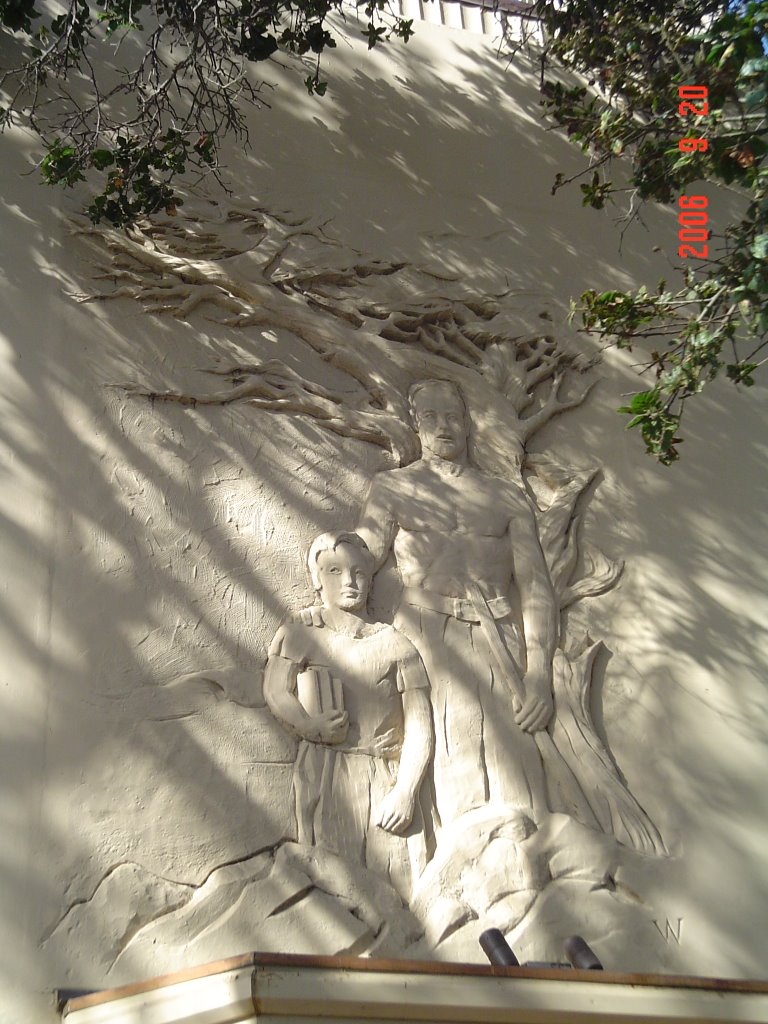
The intaglio in the above photo is the other intaglio on the south facade of the building; this intaglio depicts Junipero Serra, carved by artist Paul Whitman

This building, associated with this man, is on the City's Inventory of Historic Resources under Criterion #3 of the California Register due to the following three reasons:
1. It is the only 1930s Art Deco Style building in Carmel-by-the-Sea.
2. It was designed by noted local architect C. J. Ryland, who also designed the original Sunset Auditorium.
3. The intaglios depicting Junipero Serra by Paul Whitman, an important local artist, are intact.
Tuesday, September 26, 2006
CLUE # 2: Who is This Man?

Intaglio on Carmel Inventory of Historic Resources Building; Built in 1938.
The intaglio depicted in the above photo is one of two prominent intaglios on this Carmel Inventory of Historic Resources building; the building is associated with this man's "first" for the City of Carmel-by-the-Sea.
Monday, September 25, 2006
WHO is This Man?
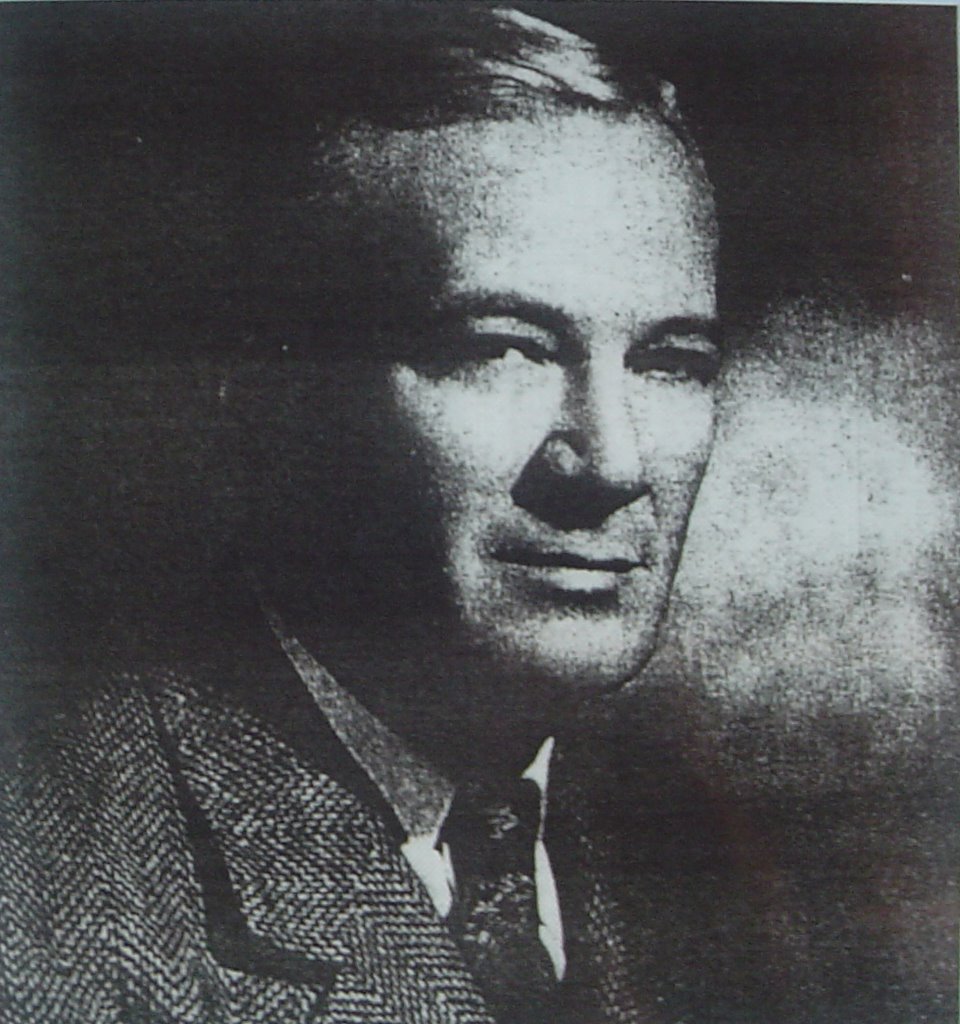
CLUE: In 1923, he founded a "first" for Carmel-by-the-Sea in the City of Carmel-by-the-Sea.
Barnet J. Segal
Banker, Businessman & Philanthropist
January 29, 1898 – September 6, 1985
1923: Established Bank of Carmel, first chartered bank in Carmel-by-the-Sea; Charter dated February 20, 1923; Opened July 23, 1923; Managed Bank of Carmel for 16 years; Later known as the Crocker Bank.
1938: Bank of Carmel building constructed in 1938 “expressly for Barnet Segal and the Bank of Carmel.”
1939: Bank of Carmel moved to “new building” at Ocean Avenue & Dolores St., N.E. Corner
(see Thursday, September 28, 2006 BLOG Post for more information)
Wednesday, August 16, 2006
"Barney's Bank"
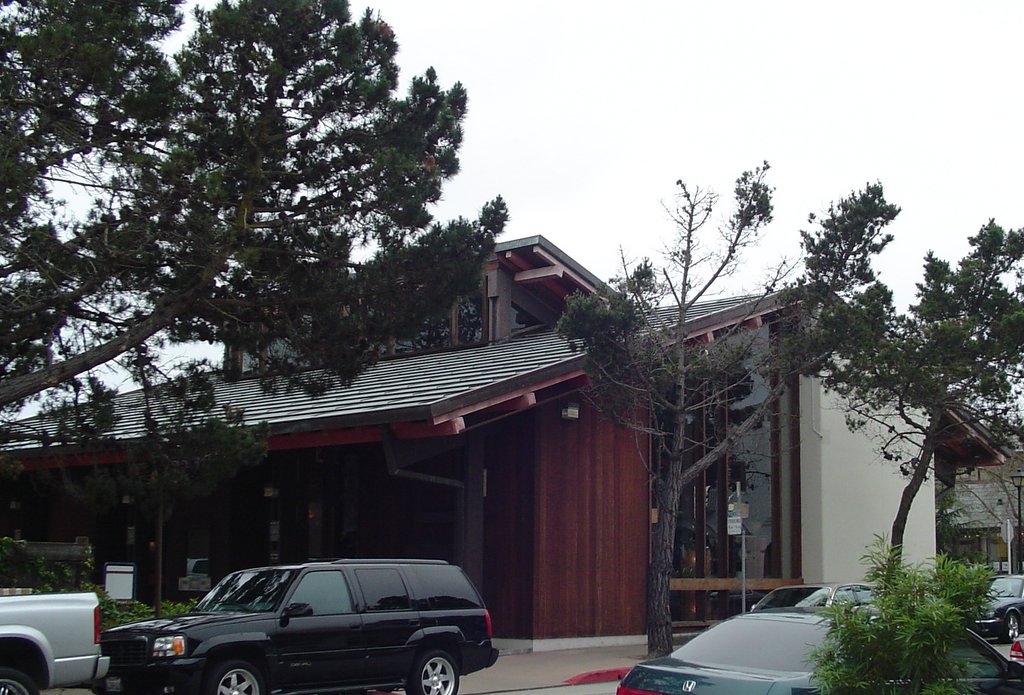
Palo Alto Savings and Loan Bank
Location: Dolores St. & 7th Av., S.E. Corner
CITY COUNCIL
Regular Meeting Agenda
Tuesday, August 8, 2006
VII. Consent Calendar
I. Adopt findings granting an appeal of a decision of the Historic Resources Board, determining the former Palo Alto Savings and Loan building to be historically significant and listing the property on the Carmel Inventory of Historic Resources. The property is located on the southeast corner of Seventh Avenue and Dolores Street. The property owner is the Pacific Grove Land Company. The appellant and project designer is John Mandurrago.
At the 8 August 2006 City Council meeting, the above Consent Calendar item was pulled; along with previously submitted written comments, Elinor Laiolo presented the following "new information" at the meeting:
“I’m Elinor Laiolo. And I would just like to say that I have asked that this item be reconsidered, although somebody else had done it before me. Because I believe there was a body of information relative to the property located at the southeast corner of Dolores and 7th Street which is now referred to as Plaza Del Mar. And that information was absent from deliberations by the council on June 6, 2006.
At that time, I was out of the country and did not know prior to my departure that a discussion on the issue was to be on that day’s agenda. The information concerns the role played by Mr. Barnet, more familiarly known a Barney, not my Barney, another Barney, the city’s lucky to have had two Barneys. Mr. Barnet Segal with Palo Alto Salinas Valley Savings and Loan Association. Barney served as Treasurer of the City of Carmel-by-the-Sea for 8 years. He had opened the first bank in Carmel-by-the-Sea with a charter from the State of California, outdoing APG & N. It started the Carmel Business Association and the Carmel Art Association as well as the Carmel Saving and Loan Association which make it possible for many folks to purchase property and construct their individual and personal homes in the years prior to and after World War II. While some material has been already accumulated, there is still information to be verified and developed.
I would ask then that the Council, which you have already put into action, I believe, to consider hearing this information in regard to the Plaza Del Mar site, which is more familiarly known to long-time residents as Barney’s Bank.
Thank you.”
Note: In 2004, Elinor Laiolo, signed Sue McCloud’s nomination papers to run for mayor. She is presently on The Carmel Foundation 2006-2007 Board of Directors, serving as Secretary.
Council Member ROSE pulled Item I from the Consent Calendar;
Council Member ROSE moved to postpone the adoption of findings and schedule the re-opening of a public hearing to allow consideration of the new information, seconded by Council Member HAZDOVAC, and carried by the following roll call:
AYES: BETHEL, HAZDOVAC, ROSE & McCLOUD
NOES: NONE
ABSENT: NONE
ABSTAIN: CUNNINGHAM
Saturday, July 15, 2006


Resource Name: Palo Alto Savings & Loan Building
Location: Dolores St. & 7th Av., S.E. Corner
The following appeal is the third appeal to the City Council regarding an appellant’s appeal of a Historic Resources Board’s decision to deny removal of an appellant’s resource from the City’s Inventory of Historic Resources.
Selected excerpts from City documents follow:
MINUTES
CITY COUNCIL MEETING
CITY OF CARMEL-BY-THE-SEA
June 6, 2006
PUBLIC HEARINGS
Consideration of an appeal of a decision of the Historic Resources Board placing a comercial structure, known as the Palo Alto Svings and Loan building, on the Carmel Inventory of Historic Resources. The building is located on the southeast corner of Seventh Avenue and Dolores Street. The property owner is the Pacific Grove Land Company. The appellant and project designer is John Mandurrago.
Brian Roseth, Principal Planner, presented the staff report.
Council Member ROSE moved to grant the appeal and remove the commercial structure, known as the Palo Alto Savings and Loan building, from the Carmel Inventory of Historic Resources, seconded by Council Member CUNNINGHAM and carried by the following roll call:
AYES: BETHEL, CUNNINGHAM & ROSE
NOES: HAZDOVAC & McCLOUD
Meeting Date: 6 June 2006
Prepared by: Elizabeth Caraker, Contract Planner
City Council
Agenda Item Summary
Name: Consideration of an appeal of a decision of the Historic Resources Board placing a commercial structure, known as the Palo Alto Savings and Loan building, on the Carmel Inventory of Historic Resources. The building is located on the southeast corner of Seventh Avenue and Dolores Street in the Service Commercial (SC) District (Blk 91, Lots 2, 4, 6, & 8, APN: 010-145-020). The property owner is the Pacific Grove Land Company. The appellant and project designer is John Mandurrago.
Description: The appellant is requesting the grant of an appeal of the Historic Resources Board placing the Palo Alto Savings and Loan building on the Carmel Inventory of Historic Resources.
Staff Recommendation: Deny the appeal and uphold the Board’s decision.
Important Considerations: CMC Section 17.32.040 lists requirements for a building to qualify as an historic resource. The property is less than 50-years old and, under National and State standards, needs to be of exceptional importance to qualify as historic. The Historic Resources Board determined that the property met this test, based on evidence in the record—including testimony from the American Institute of Architects, Monterey Bay Chapter. Evidence supporting this decision included the significance of the architect, the beauty of the design, the importance of the California Bay Area Tradition architectural style and the contribution this building makes to the diversity of design in Carmel.
The Board’s decision is final unless overturned by the City Council. If the building is historic, the Plaza Del Mar project cannot be approved unless modified to incorporate the historic building into the design. The applicant/appellant has stated this is not economically feasible. The City Council can affirm or overturn the Board’s Determination. If the appeal is granted, the property will be removed from the Inventory. If the appeal is denied, the property will remain on the Inventory.
Decision Record: On 8 December 2005, the Department of Community Planning and Building issued a Preliminary Determination of Ineligibility for the Carmel Inventory of Historic Resources. On 14 December 2005, the Monterey Bay Chapter of the American Institute of Architects filed an appeal. On 19 December 2005, the Historic Resources Board considered the appeal and reversed staff’s determination. On 23 January 2006, the Board adopted Findings for Decision supporting its determination, and placing the property on the Carmel Inventory.
CITY OF CARMEL-BY-THE-SEA
DEPARTMENT OF COMMUNITY PLANNING AND BUILDING
DRAFT FINDINGS FOR DECISION AND CONDITIONS
The Historic Resources Board determined that the Palo Alto Savings and Loan building does qualify a historic resource for the following reeasons:
• The building was designed by Walter Burde. This architect was exceptional in the quality and execution of his designs, his professionalism and his contribution to architecture within Carmel and the region. Walter Burde was generous in his support for other, younger architects, and was respected by his peers.
• Walter Burde received the AIA Monterey Bay Chapter Award of Merit in 1959 and again in 1973.
• Walter Burde received the Governor’s Design award in 1966.
• The American Institute of Architects honored Walter Burde at both regional and national levels. He was accepted as a Fellow of the Institute in 1969, one of only two or three architects awarded this honor in the entire Central Coast area. This is the second highest honor that the AIA can bestow upon an architect.
• The Palo Alto Savings and Loan building is of exceptional importance. It is a pure, original and unique example of modern architecture in the Second Phase of the Bay Regional Style.
• The building is heroic in scale and disign, one of only a few in Carmel that achieve this distinction and the best of its kind built in the past 74 years in Carmel.
• The building is extremely well preserved, in contrast to the few other buildings of this time and by this architect.
• Since the City lacks an updated Historic Context Statement with which to evaluate potential historic resources, the Board must be extremely cautious in its determinations about what qualifies as historic so that important historic resources are not lost through ignorance of their significance.
• The Palo Alto Savings and Loan building provides the City with diversity in architecture, as encouraged by the City’s General Plan/Coastal Land Use Plan.
• The building reflects its time. It avoids the cloying mimicry of historical styles of the past so prevalent in recent commercial projects that robs the community of the potential enjoyment of diverse, progressive, modern architecture reflecting the current era.
CONCLUSION
For these reasons the Palo Alto Savings and Loan building does rise to the level of exceptional importance required to qualify a building of less than 50 years in age. It should be recognized as an historic resource so that future generations can enjoy and appreciate the quality and diversity of this architecture as an excellent example of the modern era, the Second Bay Regional style, and as one of the most important architects within this region.
CITY OF CARMEL-BY-THE-SEA
HISTORIC RESOURCES BOARD
MINUTES
19 December 2005
APPLICATION
Palo Alto Saving & Loan
SE Cor. Dolores & 7th
Consideration of an appeal of a Preliminary Determination of Ineligibility for the Carmel Inventory of Historic Resources and recommendation’s to the Planning Commission on the adequacy of an Environmental Impact Report for the demolition of a commercial structure and the construction of a mixed-use project in the Service Commercial (SC) District.
Board member Coss moved grant the appeal and to place the building on the City’s Inventory of Historic Resources, seconded by Lagerholm and carried by the following roll call vote:
AYES: DYAR, COSS, LAGERHOLM
NOES: WENDT
ABSENT: HOLZ
Subscribe to:
Posts (Atom)