Update on Friends of Carmel Cultural Heritage appeal of the Historic Resources Board's 23 January 2006 decision to remove 45 post-1940 properties from the Inventory of Historic Resources pending completion of an update of the Historic Context Statement.
At the 7 March 2006 Carmel-by-the-Sea City Council meeting, the above referenced appeal was continued by the City Council.
Transcript from the 7 March 2006 City Council meeting, Public Hearing, Appeal.
Mayor Sue McCloud: "The next item is Public Hearings. This was, as I mentioned in the beginning, Consideration of an Appeal of a Decision of the Historic Resources Board to remove properties from the Historic Resources Inventory that were developed between 1940-1956. And staff is...Brain, do you want to..
Principal Planner Brian Roseth: "Thank you Madam Mayor and members of the City Council. Before I go into this, I would like to give..."
McCloud: "We're not going to go into it, we are going to continue it."
Roseth: "Oh, I'm sorry."
McCloud: "Remember?"
Roseth: "I wasn't here at the beginning of the meeting. That saves me all this.
Laughter.
City Administrator Rich Guillen: "Yes. Staff is recommend we continue this item because we need further review of the issues,(pause) mainly with the Coastal Commission.
McCloud: "The Coastal Commission contacted us on Friday afternoon and because of their schedule this week down here, there is otherwise not time to get together with them. So, and Don you have talked to the attorneys...So, we've agreed that we would...with Susan Brandt-Hawley and the Coastal Commission...We would postpone, continue this."
Councilman Gerard Rose: "So the gist, as I understand it, is that we are postponing this so that our staff can speak to the staff of the Coastal Commission about this proposal. Is that right?"
McCloud: "It's a large...It's...Yeah."
Guillen: "That's correct."
Later that week, on Thursday, 9 March 2006, Enid Sales, Director of the Carmel Preservation Foundation, orally recited her letter to California Coastal Commission Chair Meg Caldwell and Members of the Coastal Commission at the Coastal Commission's meeting in Monterey.
Letter to Chair Meg Caldwell, and Members of the Coastal Commission from Enid Sales, director of the Carmel Preservation Foundation
CARMEL PRESERVATION FOUNDATION
P.O. BOX 3959 ~ CARMEL, CA 93921
CALIFORNIA COASTAL COMMISSION MARCH 7, 2006 MONTEREY, CALIFORNIA
TO: Chair Meg Caldwell, and Members of the Coastal Commission
FROM: Enid Sales, Director of the Carmel Preservation Foundation
RE: Request of an Overview of Commission Staff of the Implementation Plan of the Local Coastal Plan for Carmel, CA.
We feel that Carmel Planning Staff consistently violates the conditions of the IP regarding Historic Resources. Our concerns are with the Inventory, the consistent refusal to include relevant evaluations of the Carmel Preservation Foundation on the Agendas of the Historic Resources Board, and the Planning Commission. Following are the violations.
1. After a letter to property owners of their inclusion on the Inventory,
they did not record these buildings as required.
2. Conducted a Workshop for Owners that explained in Planning terms not too
clearly what the requirements are, but did not support the Preservation
Program. Instead they blamed the Coastal Commission because they had
made the City select an Inventory and have such a Program.
3. The City upset Owners at this meeting to such an extent that 93 requests
were made to have their properties removed from the Inventory and there
are only 300 Resources altogether on the Inventory.
4. Finding it onerous to deal with buildings one by one, their next
strategy was to remove 45 more properties from the Inventory because
they were built after 1940, the date that the Context Statement stops
its historic evaluation.
a. The Context is advisory not regulatory.
b. The Planning Department has the responsibility of updating the
Statement every five years.
c. An appeal was filed re these 45 buildings by CPF, and was
scheduled, by Municipal Code to be at the first meeting after
the filing, which was Tuesday, and the Council continued the
hearing without setting a future date even though it was
publicly requested.
5. Since the LCP was certified in October 2004, the City has misused the
methodology for determining what properties are and are not historic.
We need your Staff to examine the their use of ineligible, loss of
integrity, age, and misuse of the Secretary of Interior's Standards.
6. There have been two requests for Mills Act Contracts, Both buildings
are on the Carmel Historic Register. Both requests have been continued
twice with no explanation for why they can't proceed. This has been
since December 2005.
We sincerely request that we can make our specific problems clear directly to Central Coast Staff so that we can be assured that the excellent Implementation Plan can be practiced correctly. Thank you.
After Enid Sales' presentation, the Chair spoke to Charles Lester, Deputy Director, Central Coast District Office, and he said he was going to speak with the Mayor. The Chair made it clear that Mr. Lester must and with what Enid Sales had requested.
On or about Friday,7 April 2006, City Administrator Rich Guillen remarked that the meeting between the City and the Coastal Commission Staff was about all of the Local Coastal Program (LCP)---this was a factually inaccurate statement. When confronted with the reasons stated by the City at the 7 March 2006 City Council meeting, Guillen refused to admit the reason for the meeting was the Historic Resources Board's decision, upon the recommendation of Principal Planner Brian Roseth, to remove 45 post-1940 properties from the Inventory of Historic Resources. Defensively, he reiterated that the meeting was not a public meeting and "I don't have to tell you."
In the context of the 2005 Monterey County Civil Grand Jury Report citing the lack of "open government" in Carmel-by-the-Sea, it is extremely disappointing, discouraging and disheartening to learn of a City Administrator who responds to a citizen's query with defensive prevarications,instead of genuine interest for a citizen's concerns.
Finally, in an April 7, 2006 Letter to The Carmel Pine Cone, Olof Dahlstrand wrote of the incumbents responses to his question on the meaning of "open government;" "the incumbents' replies showed their continuing misunderstanding of this concept which has dogged them for several years. (The reluctance of the incumbents to support an open public discussion of the issues in the privatization of the management of Sunset Center comes to mind.)" Is it any wonder then, that the City Administrator, who serves at the pleasure of the City Council, similarly suffers from a "continuing misunderstanding" of open government?" The City Administrator and the Members of the Carmel-by-the-Sea City Council just don't get it and never will get it!
Saturday, April 08, 2006


Wednesday, April 05, 2006
This One Is For Chet Lowney


Location: Guadalupe St., North of Mt. View Av., near Forest Theater gate on Guadalupe St.
City's Removal of 43 Historic Inventory Properties
Herewith is a Chronology Of Events of the City's Removal of 43 Properties from the City's Inventory of Historic Resources.
1. Certification of Local Coastal Program (LCP), November 2004.
2. Mayor Sue McCloud’s 10 June 2005 letter notifying property owners that their residences/commercial buildings are on the City’s Inventory of Historic Resources (part of the LCP).
3. Approximately 93 “historic” property owners filed appeals to remove their residences/commercial buildings from the Inventory of Historic Resources.
4. Upon the recommendation of Principal Planner Brian Roseth, the Historic Resources Board removed "all post-1940 properties from the Inventory of Historic Resources pending completion of an update of the Historic Context Statement" at their 23 January 2006 meeting.
5. Friends of Carmel Cultural Heritage appealed the Historic Resources Board’s decision to “temporarily remove” 43 properties from the Inventory of Historic Resources, 2 February 2006. Representing Friends of Carmel Cultural Heritage, Attorney Susan Brandt-Hawley wrote:
"The precipitous removal of properties from the Inventory violates the LCP, including but not limited to sections P1-84,85,88, and 91, and also violates the Carmel Municipal Code, including but not limited to section 17.32.070, and also violates the California Environmental Quality Act."
6. Communication with City Attorney Don Freeman revealed the City’s position that the City was not under any obligation or requirement to place the appeal on a City Council agenda in a timely manner. Yet, the Carmel-by-the-Sea Municipal Code states:
Chapter 17.54
APPEALS
17.54.040 Filing Appeals.
C. Appeals to the City Council.
2. Within 10 working days after receipt of an appeal the City Clerk shall set a date for public hearing at which the appeal shall be considered by the City Council. All appeals shall be set for the next regular City Council meeting, unless insufficient time exists for public notice as established in CMC 17.54.090, Notice of Hearing.
7. The City places the Friends of Carmel Cultural Heritage appeal of the Historic Resources Board’s decision on the 7 March 2006 agenda.
8. At the 7 March 2006 City Council meeting, the City Council continued the appeal indefinitely, without setting a specific future City Council meeting date, as is customary procedure for cities. Mayor McCloud cited the need to confer with the California Coastal Commission staff as the reason for the continuance and stated that she did not know when the appeal would be heard because of uncertainly associated with the Coastal Commission staff’s schedule.
9. The Friends of Carmel Cultural Heritage appeal was not on the 4 April 2006 City Council agenda and therefore was not given a public hearing at the meeting.
The future of the Friends of Carmel Cultural Heritage appeal remains uncertain.
1. Certification of Local Coastal Program (LCP), November 2004.
2. Mayor Sue McCloud’s 10 June 2005 letter notifying property owners that their residences/commercial buildings are on the City’s Inventory of Historic Resources (part of the LCP).
3. Approximately 93 “historic” property owners filed appeals to remove their residences/commercial buildings from the Inventory of Historic Resources.
4. Upon the recommendation of Principal Planner Brian Roseth, the Historic Resources Board removed "all post-1940 properties from the Inventory of Historic Resources pending completion of an update of the Historic Context Statement" at their 23 January 2006 meeting.
5. Friends of Carmel Cultural Heritage appealed the Historic Resources Board’s decision to “temporarily remove” 43 properties from the Inventory of Historic Resources, 2 February 2006. Representing Friends of Carmel Cultural Heritage, Attorney Susan Brandt-Hawley wrote:
"The precipitous removal of properties from the Inventory violates the LCP, including but not limited to sections P1-84,85,88, and 91, and also violates the Carmel Municipal Code, including but not limited to section 17.32.070, and also violates the California Environmental Quality Act."
6. Communication with City Attorney Don Freeman revealed the City’s position that the City was not under any obligation or requirement to place the appeal on a City Council agenda in a timely manner. Yet, the Carmel-by-the-Sea Municipal Code states:
Chapter 17.54
APPEALS
17.54.040 Filing Appeals.
C. Appeals to the City Council.
2. Within 10 working days after receipt of an appeal the City Clerk shall set a date for public hearing at which the appeal shall be considered by the City Council. All appeals shall be set for the next regular City Council meeting, unless insufficient time exists for public notice as established in CMC 17.54.090, Notice of Hearing.
7. The City places the Friends of Carmel Cultural Heritage appeal of the Historic Resources Board’s decision on the 7 March 2006 agenda.
8. At the 7 March 2006 City Council meeting, the City Council continued the appeal indefinitely, without setting a specific future City Council meeting date, as is customary procedure for cities. Mayor McCloud cited the need to confer with the California Coastal Commission staff as the reason for the continuance and stated that she did not know when the appeal would be heard because of uncertainly associated with the Coastal Commission staff’s schedule.
9. The Friends of Carmel Cultural Heritage appeal was not on the 4 April 2006 City Council agenda and therefore was not given a public hearing at the meeting.
The future of the Friends of Carmel Cultural Heritage appeal remains uncertain.
City's Unilateral Action
Unilaterally, the City of Carmel-by-the-Sea’s Community Planning & Building Department Staff has redefined and embellished the “reasons” cited in the City’s Local Coastal Program (LCP) for the removal of properties from the City’s Inventory of Historic Resources.
The relevant section of the LCP, General Plan/Coastal Land Use Plan Land Use & Community Character Element, Cultural Resources, Historic Preservation
states:
P1-91 Establish procedures for the Historic Preservation Board, based on
recommendations from qualified professionals, to remove historic resources from the Carmel Inventory based on substantial evidence (e.g. incorrect evidence, invalid analysis, or loss of integrity of the identified historic resource). An historic resource listed on the Carmel Inventory shall be presumed historically significant and shall not be removed unless substantial evidence demonstrates that
it is not an historic resource. (LUP)
Yet, in the City's 4 April 2006 Staff Report for the Doris M. Rayne Trust appeal of the Historic Resources Board’s unanimous decision to deny a request to remove the property from the City’s Inventory of Historic Resources located in the Central Commercial and Downtown Conservation Overlay Districts, the Staff Report states:
“Staff recognizes four possible reasons for removing a property from the Carmel Inventory: 1) There are gross, non-correctable errors in the historic documentation, 2) The property bears a poor or minimal relationship to the adopted Historic Context Statement, 3) There are a sufficient number of other, better preserved or more important resources of the same type elsewhere within the City, and 4)The resource has lost its historic integrity through past alterations.”
These changes/additions were created and implemented by the City without public hearings at the Historic Resources Board and City Council levels.
CONCLUSION: Without checks and balances, it appears that the staff in the City’s Community Planning & Building Department is implementing policy that is not articulated in the LCP and without public deliberation at the Historic Resources Board and City Council levels.
The relevant section of the LCP, General Plan/Coastal Land Use Plan Land Use & Community Character Element, Cultural Resources, Historic Preservation
states:
P1-91 Establish procedures for the Historic Preservation Board, based on
recommendations from qualified professionals, to remove historic resources from the Carmel Inventory based on substantial evidence (e.g. incorrect evidence, invalid analysis, or loss of integrity of the identified historic resource). An historic resource listed on the Carmel Inventory shall be presumed historically significant and shall not be removed unless substantial evidence demonstrates that
it is not an historic resource. (LUP)
Yet, in the City's 4 April 2006 Staff Report for the Doris M. Rayne Trust appeal of the Historic Resources Board’s unanimous decision to deny a request to remove the property from the City’s Inventory of Historic Resources located in the Central Commercial and Downtown Conservation Overlay Districts, the Staff Report states:
“Staff recognizes four possible reasons for removing a property from the Carmel Inventory: 1) There are gross, non-correctable errors in the historic documentation, 2) The property bears a poor or minimal relationship to the adopted Historic Context Statement, 3) There are a sufficient number of other, better preserved or more important resources of the same type elsewhere within the City, and 4)The resource has lost its historic integrity through past alterations.”
These changes/additions were created and implemented by the City without public hearings at the Historic Resources Board and City Council levels.
CONCLUSION: Without checks and balances, it appears that the staff in the City’s Community Planning & Building Department is implementing policy that is not articulated in the LCP and without public deliberation at the Historic Resources Board and City Council levels.
Sunday, April 02, 2006
Sunset Cultural Center, Inc.: Annual Public Meeting
HIGHLIGHTS OF THE SUNSET CULTURAL CENTER, INC.'S ANNUAL PUBLIC MEETING
Saturday, April 1, 2006 at Carpenter Hall, 10:00 A.M.
Present:
Six Sunset Cultural Center, Inc. (SCC) Board of Directors
Chair Perry Walker, Treasurer Sarah Brown (Accounting & Finance), Michael McMahan (Governance), Demi Briscoe (Human Resources), Jim Price (Building & Grounds), Katherine Bucquet (Leases) and Executive Director Jack Globenfelt.
Absent:
Three SCC Directors
Vice Chair Fred O'Such (Marketing), Secretary Karen Kadushin, Steven Hillyard.
In Audience,
Present:
One City Council Member, Mayor Sue McCloud
Absent:
Four City Council Members; Councilwoman Paula Hazdovac, Councilman Gerard Rose, Councilman Michael Cunningham, Councilman Erik Bethel.
Format of Annual Public Meeting:
Chair Perry Walker gave a brief introduction; presently SCC is in the second year of our three year contract, SCC is "learning to run the theater," SCC's mission is to maximize potential of theater for "patrons of Monterey County and beyond." Then Walker solicited questions from the audience of about 28 people.
Audience comments included:
1. Carmel Opera Festival representative recalled contacting Executive Director Globenfelt in January 2006 through SCC web site and never received a response.
2. Friends of Sunset long-time volunteer voiced amazement that in 2 years SCC has not addressed rate structure for rental rooms for not-for-profit organizations vs. for-profit groups.
3. Member of the public expressed concern that since the City has problems with open government (as reported in the 2005 Monterey County Civil Grand Jury Report), citizens are denied complete SCC financial reports.
Responses from Chair Perry Walker:
1. On a trend line of reducing the city subsidy to operate Sunset Center.
2. SCC views the Sunset Center theater as a "regional theater."
3. SCC's mission is to establish the Sunset Center theater as a "Brand;" a brand associated with "premier," quality performing arts performances.
4. Sunset Center theater is a "difficult venue to book" because it is so expensive as a 718 seat theater.
5. Some performances are sold out (ex. Lily Tomlin, The Tempations), while other performances attract 200 people.
6. Sunset Center performs art, does not create art.
7. Conventions, "not practical;" conferences o.k.
8. Vision for Box Office ticketing for all presenters not realized ie. Many presenters sell tickets to their patrons directly.
9. SCC Web Site: 8000 visits (of 3-4 minutes/visit) per month and a 1000 person e-mail list.
10. 14% of total tickets purchased are by Carmel-by-the-Sea residents.
11. By June 30 2007 (end of first 3 year contract), SCC renegotiates contract with City and Sunset Center Union Employees.
Final Thoughts:
SCC Board of Directors and Executive Director gave no formal presentation to the public ex. No power point presentation on the past year, future expectations, etc., no written material on past year, etc. provided to attendees. Ergo, for the one and only public meeting of the year, there was evidence of a lack of preparation and thought by the SCC Board of Directors and the Executive Director. Hence, a lack of respect for the public's right to be informed about Sunset Center operations under SCC management was shown by the SCC Board and the Executive Director.
Repetitive Mantra by Chair Perry Walker, Michael McMahan and Treasurer Sarah Brown; Achieving our goal of reducing the subsidy from the City.
Actual Record:
FY 2004/05 (SCC's first year of management):
$762,000 (4 quarterly "Enabling Grants")
$105,000 (Start-Up Grant for Web Site, Box Office Ticketing, etc.)
Total City Subsidy: $867,000
Plus $120,000 "Working Capital Advance" (Treasurer Sarah Brown confirmed that SCC does not intend to use any of loan and SCC will pay back loan by end of third year ie. June 30, 2007.)
FY 2005/06 (SCC's second year of management):
$772,000 (4 quarterly "Enabling Grants")
Note: SCC's claim that the City spent $806,000 for the Sunset Center in FY 2003/04 is not an actual figure based on the City's FY 2003/04 audit, rather it is an SCC "estimate." (Source: W. Craig Robertson, Director of Finance & Administration, Sunset Cultural Center, Inc.)
Reflecting on the SCC Annual Public Meeting, I am reminded of a statement in the 2005 Monterey County Civil Grand Jury Report: "Whether or not the public interest is being subverted through any covert process may be immaterial if the public has the perception their interests are not represented and outcomes are predetermined."
It is my impression that the Board of Directors and the Executive Director, at times other than at this public meeting, are aloof, non-responsive and unaccountable for their actions to the public. Moreover, their lack of complete disclosure and candidness does not portend well for the future.
RECOMMENDATION: At the third Annual Public Meeting in 2007 the SCC Board of Directors and Executive Director should make a formal presentation to the public covering FY 2004/05 and FY 2005/06, FY 2006/07, future expectations, etc. This approach would succeed in not only informing the public about SCC management operations, but it would demonstrate a recognition and commitment to the public/not-for-profit organization partnership that is now Sunset Center.
Saturday, April 1, 2006 at Carpenter Hall, 10:00 A.M.
Present:
Six Sunset Cultural Center, Inc. (SCC) Board of Directors
Chair Perry Walker, Treasurer Sarah Brown (Accounting & Finance), Michael McMahan (Governance), Demi Briscoe (Human Resources), Jim Price (Building & Grounds), Katherine Bucquet (Leases) and Executive Director Jack Globenfelt.
Absent:
Three SCC Directors
Vice Chair Fred O'Such (Marketing), Secretary Karen Kadushin, Steven Hillyard.
In Audience,
Present:
One City Council Member, Mayor Sue McCloud
Absent:
Four City Council Members; Councilwoman Paula Hazdovac, Councilman Gerard Rose, Councilman Michael Cunningham, Councilman Erik Bethel.
Format of Annual Public Meeting:
Chair Perry Walker gave a brief introduction; presently SCC is in the second year of our three year contract, SCC is "learning to run the theater," SCC's mission is to maximize potential of theater for "patrons of Monterey County and beyond." Then Walker solicited questions from the audience of about 28 people.
Audience comments included:
1. Carmel Opera Festival representative recalled contacting Executive Director Globenfelt in January 2006 through SCC web site and never received a response.
2. Friends of Sunset long-time volunteer voiced amazement that in 2 years SCC has not addressed rate structure for rental rooms for not-for-profit organizations vs. for-profit groups.
3. Member of the public expressed concern that since the City has problems with open government (as reported in the 2005 Monterey County Civil Grand Jury Report), citizens are denied complete SCC financial reports.
Responses from Chair Perry Walker:
1. On a trend line of reducing the city subsidy to operate Sunset Center.
2. SCC views the Sunset Center theater as a "regional theater."
3. SCC's mission is to establish the Sunset Center theater as a "Brand;" a brand associated with "premier," quality performing arts performances.
4. Sunset Center theater is a "difficult venue to book" because it is so expensive as a 718 seat theater.
5. Some performances are sold out (ex. Lily Tomlin, The Tempations), while other performances attract 200 people.
6. Sunset Center performs art, does not create art.
7. Conventions, "not practical;" conferences o.k.
8. Vision for Box Office ticketing for all presenters not realized ie. Many presenters sell tickets to their patrons directly.
9. SCC Web Site: 8000 visits (of 3-4 minutes/visit) per month and a 1000 person e-mail list.
10. 14% of total tickets purchased are by Carmel-by-the-Sea residents.
11. By June 30 2007 (end of first 3 year contract), SCC renegotiates contract with City and Sunset Center Union Employees.
Final Thoughts:
SCC Board of Directors and Executive Director gave no formal presentation to the public ex. No power point presentation on the past year, future expectations, etc., no written material on past year, etc. provided to attendees. Ergo, for the one and only public meeting of the year, there was evidence of a lack of preparation and thought by the SCC Board of Directors and the Executive Director. Hence, a lack of respect for the public's right to be informed about Sunset Center operations under SCC management was shown by the SCC Board and the Executive Director.
Repetitive Mantra by Chair Perry Walker, Michael McMahan and Treasurer Sarah Brown; Achieving our goal of reducing the subsidy from the City.
Actual Record:
FY 2004/05 (SCC's first year of management):
$762,000 (4 quarterly "Enabling Grants")
$105,000 (Start-Up Grant for Web Site, Box Office Ticketing, etc.)
Total City Subsidy: $867,000
Plus $120,000 "Working Capital Advance" (Treasurer Sarah Brown confirmed that SCC does not intend to use any of loan and SCC will pay back loan by end of third year ie. June 30, 2007.)
FY 2005/06 (SCC's second year of management):
$772,000 (4 quarterly "Enabling Grants")
Note: SCC's claim that the City spent $806,000 for the Sunset Center in FY 2003/04 is not an actual figure based on the City's FY 2003/04 audit, rather it is an SCC "estimate." (Source: W. Craig Robertson, Director of Finance & Administration, Sunset Cultural Center, Inc.)
Reflecting on the SCC Annual Public Meeting, I am reminded of a statement in the 2005 Monterey County Civil Grand Jury Report: "Whether or not the public interest is being subverted through any covert process may be immaterial if the public has the perception their interests are not represented and outcomes are predetermined."
It is my impression that the Board of Directors and the Executive Director, at times other than at this public meeting, are aloof, non-responsive and unaccountable for their actions to the public. Moreover, their lack of complete disclosure and candidness does not portend well for the future.
RECOMMENDATION: At the third Annual Public Meeting in 2007 the SCC Board of Directors and Executive Director should make a formal presentation to the public covering FY 2004/05 and FY 2005/06, FY 2006/07, future expectations, etc. This approach would succeed in not only informing the public about SCC management operations, but it would demonstrate a recognition and commitment to the public/not-for-profit organization partnership that is now Sunset Center.
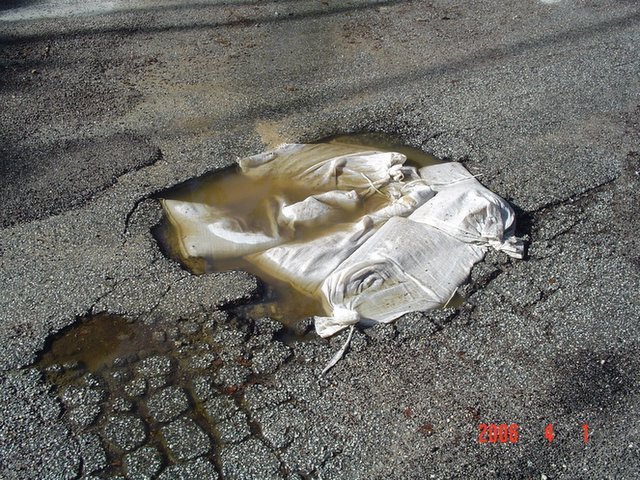
Pothole Town: The Condition of Our Streets

(Location: Torres St. between 8th Av. & Mt. View Av.)
In a Sunday, April 2, 2006 Letter to the Editor, a Carmelite wrote about his "pet peeve --- the continued neglect of the village's streets. They have grown steadily worse over the years under the present administration's fiscal cutback policies."
For a village of:
1 square mile
4,000 permanent residents
$11.2 million annual budget
$7-8 million reserves
the degraded condition of our streets is SHAMEFUL!
Subscribe to:
Posts (Atom)